The Statement She Didn't Plan
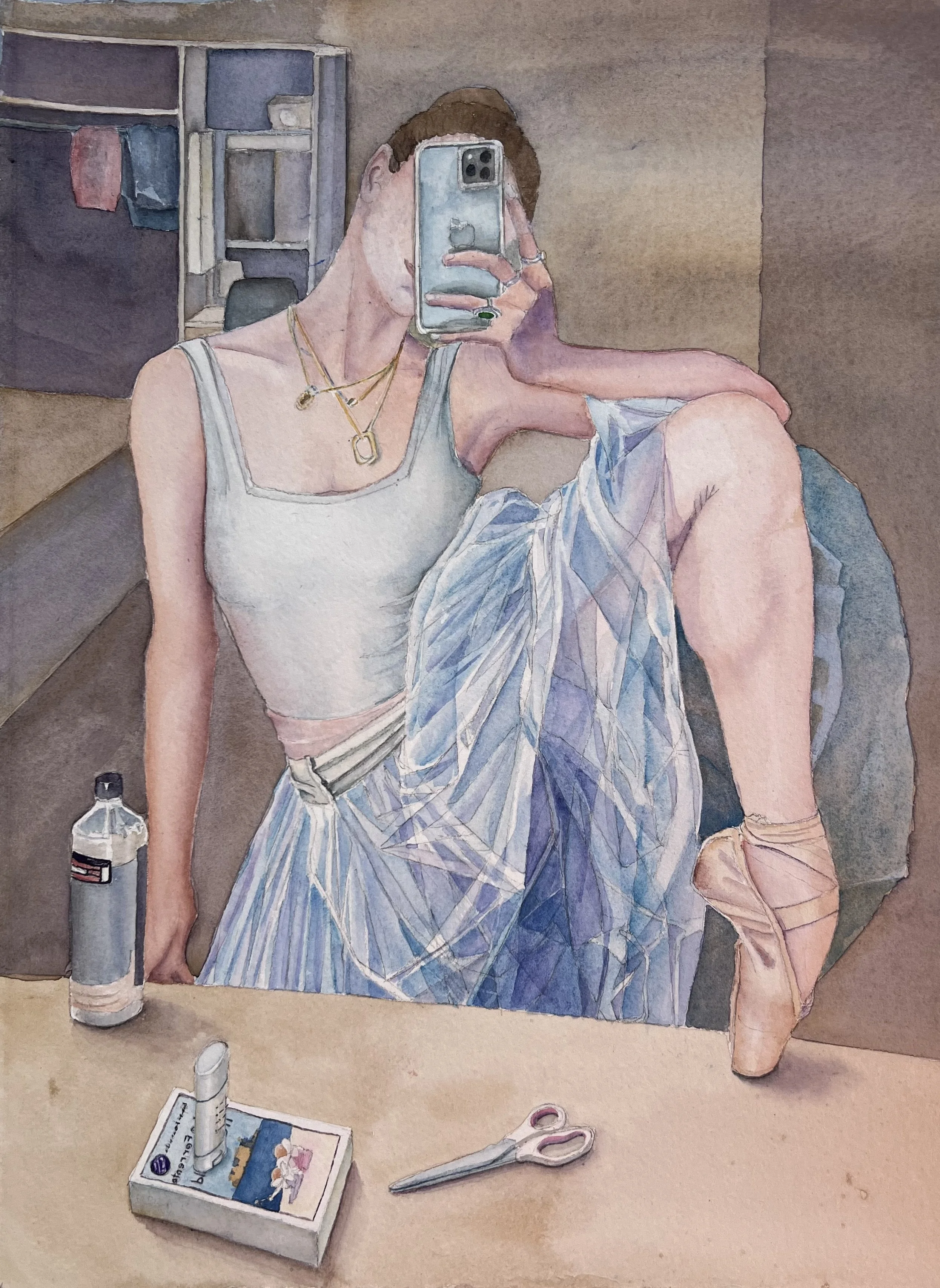
This is the painting I want to talk about today.
A dancer in her dressing room, in rehearsal leotard and skirt, sitting at ease amid the honest clutter of a working performer’s life — scissors, water, the tools of transformation scattered across the counter. And where her face should be, the phone. Held up deliberately, covering everything that would make her most recognizable, most vulnerable, most seen.
I found this image on Cassandra Trenery’s social media feed and was immediately drawn to it.
I believe she raised the phone to take a picture — casually, intuitively, the way dancers document their lives between performances — and when she looked at what she had captured, she saw something in it that felt true. A statement. And she chose to post it because something in that image said what she wanted to say, even if she couldn’t have fully articulated what that was before she saw it. She recognized the meaning of the hidden face after the fact — in the image itself — and decided to share it. That recognition was its own creative act.
The phone covering her face became a statement about the relationship between self-presentation and identity. On stage she performs for an audience that has purchased the right to look at her — every gesture, every expression, every interior state managed and offered on terms the performance sets. On social media she sets her own terms. She chooses what to show and what to withhold. The hidden face isn’t a loss of self. It is an assertion of self. She is showing you her world — her body, her costume, her dressing room, the whole apparatus of what it takes to be a dancer — while keeping the most intimate part of herself exactly where she wants it.
When I painted this image I spent hours with it — rendering the dressing room in precise detail, the costume, the hand holding the phone, the space where her face should be. And somewhere in those hours I recognized something I hadn’t expected to find.
Her process and mine are not so different.
I didn’t begin my painting practice with a fully formed conceptual framework about the interior lives of dancers and the gap between exterior performance and interior truth. I painted what I loved and what I needed to paint. I followed the desire without fully understanding where it was leading. And gradually, painting after painting, the meaning clarified. What I was doing became visible to me only after I had already been doing it — the way you sometimes understand a decision only after you have lived it.
She snapped a photo and saw its truth in the image. I have been making paintings and discovering their meaning as I go. Both of us working intuitively toward something that only becomes fully visible in retrospect.
What her photograph says — and what my painting tries to hold and slow down — is something larger than one dancer in one dressing room. We live in a culture that asks us to be constantly visible, constantly presenting a self for an audience we can’t fully see or control. Social media has extended that demand into every private space of a dancer’s life. And yet within that demand, there is still agency. The capacity to hold the phone in front of your face and say: you can see my world but not my eyes. You can see what I carry but not what I feel. The performance doesn’t own all of me.
Painting a social media photograph is an act of restoration — returning to the image the interiority that the platform was designed to remove. A scroll becomes a sustained gaze. In that slowness, what the dancer is actually carrying becomes visible — not despite her concealment, but through it. The hidden face reveals more about identity, agency, and self-presentation than any posed smile could.
The dancers are seen — fully, privately, with loving attention — in the gap between what they offer and what they withhold.
She made a statement she didn’t fully plan. I made a painting trying to understand it. And somewhere between her intuition and mine, something true about what it means to be seen for who you are became visible.
This painting lies in the gap between the image offered and the truth it carries.
— Jill