What Dance Left Behind: An Essay for Dance Magazine
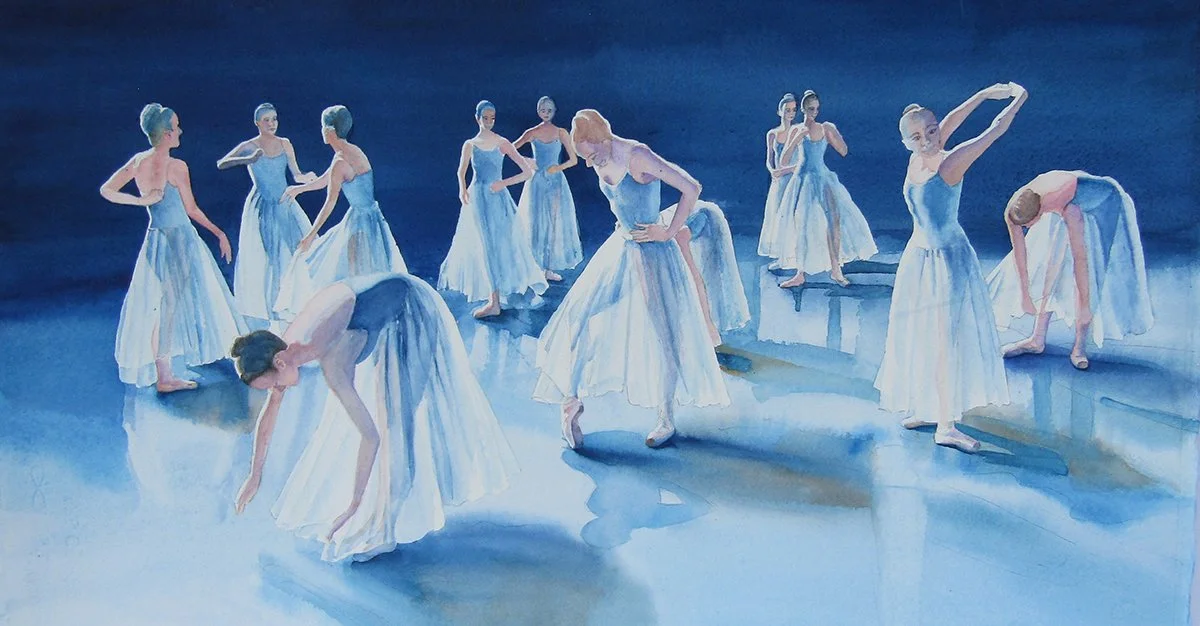
I started drawing dancers in high school. Then painting them.
Not exclusively—there were other subjects, other explorations, the way an artist moves through the world trying to understand what she is drawn to and honing technical skills—similar to dance training. Dance was the subject I came back to again and again, the way you hear a melody from the studio and can’t quite get it out of your head because it is what your body is exploring.
For decades I lived inside dance — as a performer, as a K-12 dance teacher in the Bronx and as an arts administrator. Painting existed alongside all of it, the parallel language spoke. I painted dancers for the same reasons I danced: because I loved it, because I needed it, because it was the form through which something essential in me could speak.
I painted what dance had given me—the way to read a body that had come from decades of dance training, teaching and performing. Even though dance had built the foundation for my painting career, I didn’t truly understand what my paintings said about dance until dancing, in the form I had always known it, was no longer available to me. And what I found on the other side of that loss is that: dance training doesn’t end when the performance ends. It finds a new form. It carries forward. It was never only about the stage.
When the teaching stopped, when the choreographing stopped, when the daily physical immersion in dance that had structured my life for decades was no longer there, I found that I only wanted to paint dancers. The desire was immediate and specific and stronger than anything I had felt about painting before. It was as though everything peripheral had been stripped away and what remained was the one essential thing—the thing dance had given me.
Movement had always been the way I understood the world, the way I processed experience, the way I stayed connected to what mattered. Now painting dancers was the only form through which that connection could continue to exist.
I had spent decades learning to read dancers. As a performer I knew the gap between how a movement looks from the outside and what it costs from the inside—the effort behind the effortlessness, the emotion beneath the form. As a teacher I had trained my eye to see anatomy, gesture, and intention simultaneously, to read a student’s body not just for technical correctness but for what it was actually expressing, what it was holding back, or what it was afraid to show. I could look at a dancer and feel, in my own body, something of what she was carrying.
I had always used this as a dance skill. Then I turned it into a painting skill.
The ability to read a dancer’s interior state became the ability to paint the psychological truth beneath the surface. Dance hadn’t left me. It had changed form.
The paintings that emerged from this transition were different from anything I had made before in their story. The work became concentrated on a single question that a lifetime in dance had uniquely prepared me to ask: what is the dancer carrying that the performance is designed to conceal?
On stage, a dancer’s entire training is oriented toward a single goal — making the interior invisible. The effort must look effortless. The pain must look like grace. The doubt, the exhaustion, the private emotional reality of a human being doing something extraordinarily difficult must be subsumed entirely into the exterior form. I had lived inside that demand for decades. I knew what it cost. And I knew that what it cost was real, and human, and worth seeing.
My paintings became an act of witness. They are portrait paintings that reach past what dance makes visible, into the psychological and felt experience beneath the performance. They are about what the dancer carries that the audience never sees.
When Michaela Mabinty DePrince died, I felt her loss the way you feel the loss of someone whose story had always mattered to you. She was not just as a dancer of extraordinary gifts, but a person who had carried an extraordinary weight and brought it with her onto every stage she ever graced. Painting her was an act of love and an act of reckoning. Her death sharpened what I already knew: that the interior lives of dancers—the psychological cost of the culture, the emotions concealed beneath the performance, the humanity behind the grace—were not incidental to the work. They were the whole point.
The same impulse led me to illustrate Lauren in the Limelight, Miriam Landis’s book about a young dancer navigating aspiration and performance. Twenty illustrations where I translated movement, ambition, and the interior experience of dance into imagery. The project confirmed what the transition had revealed: that leaving the studio had not ended my relationship with dance. It had opened a new conversation — one I could only have from where I now stood, outside the form, looking in with the eyes of someone who had lived inside it completely.
Painting was always there. It took the loss of physical dancing to discover what my interior life had been waiting to say.
I think about the dancer I was, drawing figures in sketchbooks when injured, returning again and again to the subject I couldn’t abandon. I didn’t know then what I was practicing. I didn’t know that decades of living inside dance were building a way of seeing that would outlast the studio, the classroom, and the performing career—that when the physicality of dance could not survive its essence was carried forward into a new form.
Dance training doesn’t end when the performance ends. It lives in the body, in the eye, in the capacity to read another person’s interior life from the outside, to feel what they are carrying before they have said a word. Whatever form that capacity finds — on stage, in a classroom, on a canvas—it came from dance.